
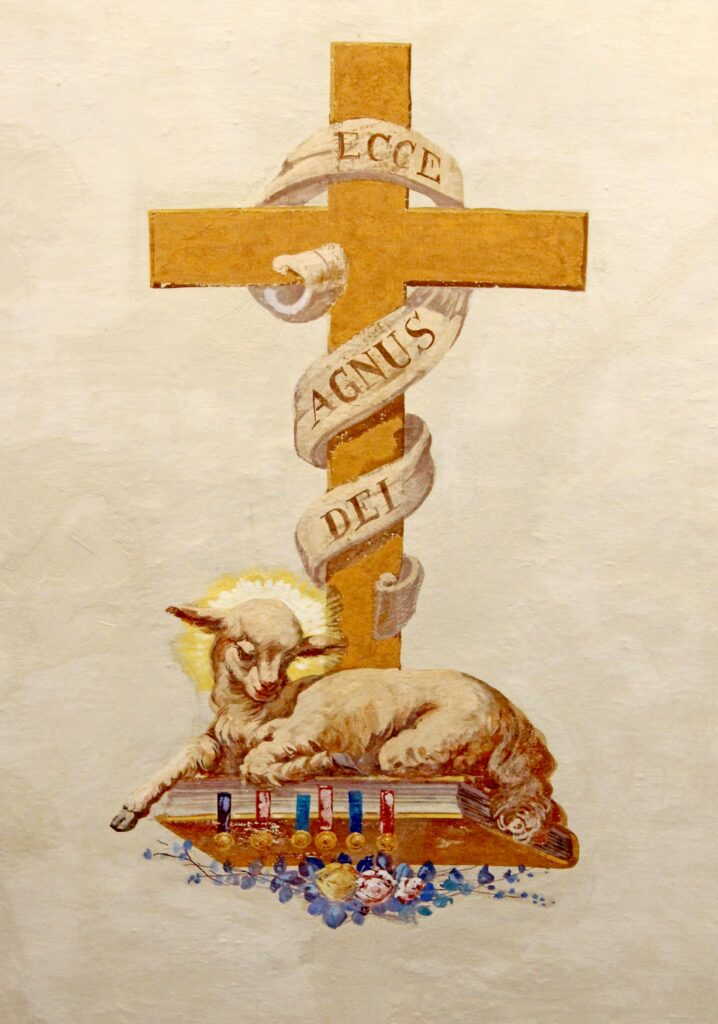
In John chapter 1:29, upon seeing Jesus walking, John the Baptist exclaims, “Behold, the Lamb of God who takes away the sin of the world.” Though this is a very short statement, these words are of no small value. It would be lacking to interpret this phrase as simply a statement of a meek and innocent being. John the Baptist twice in this first chapter (1:29, 36) heralds Jesus as the Lamb of God; 1:29 includes the mission statement of Jesus as well.
It was this John who was prophesied to be the one crying in the wilderness to announce the Messiah. In this one sentence John captures the essence of the Old Testament sacrificial system, and identifies the Person and mission of Christ.
Jesus is the Shepherd, the Door, and subsequently we find here that He is the sacrificial Lamb as well. The word lamb evokes the sacrificial legacy of Israel—hands of the penitent placed upon the intended innocent sacrifice in order to “transfer” sin. The description, “who takes away the sin of the world,” communicates both the nature and scope of His work.
He alone is perfect, sinless, chosen and anointed. Only the blood of the Eternal Son, struck down, could be accepted as the viable currency of forgiveness. This blood doesn’t just cover, but it takes away—removes—the sin of the world—as far as the East is from the West.
Jesus is truly God, and truly Man, but God cannot die as He is eternal Spirit. And so, the incarnation—“BUT A BODY YOU HAVE PREPARED FOR ME” (Hebrews 10:5). Our sin is placed upon this Lamb; He becomes sin on our behalf. He dies on the altar of the Cross in our place. He atones for sin. He surrenders His spirit to the Father, and we become the righteousness of God in Him (2 Corinthians 5:21).
His sacrifice would fulfill the Old Testament system. All other subsequent sacrifices (allegedly deemed meritorious to deliver salvation) would not only be obsolete and ineffective, but more so, they would be offensive to God as they would serve to undermine, or negate the sufficiency of the work of Christ. Subsequent to this work, praise and thanksgiving for the ultimate sacrifice of Christ are the only sacrifices required.
By faith in Christ alone is one justified, and pronounced, or declared, once and for all, righteous on the basis of the work of Christ, in His shed blood.
To behold the Lamb of God who takes away the sin of the world is key to salvation in Christ:
- Behold: consider, evaluate, dwell upon the wrath of God poured out as penalty for sin upon Christ as He stood in our place as the object of that wrath in order to appease, or satisfy the debt of sin.
- Lamb of God: Divinely provided provision for deliverance from the consequences of sin— the sole Sin-bearer of Substitutionary Atonement. And indeed, Jesus is God Himself.
- His death and resurrection are the fulfillment of the Law, the end of sacrifices—Our resultant hope for eternity with Him.
Paul writes this in First Corinthians, “For Christ, our Passover Lamb, also was sacrificed” (1 Corinthians 5:7). The Passover Lamb, again referencing the absolution of sin through the sacrifice of another which gained our freedom.
“Behold, the Lamb of God who takes away the sin of the world.” Are not these words of John the core of the Gospel? We entreat those lost to consider Christ. We plead that those doomed under the weight of sin would be delivered. As we come to truly know the Person, the nature and scope of His atonement, and embrace them—we are in Christ!






Thanks for these wise words
You Mine Pastor, will be so missed i dont even know what to say. Yahway is on His throne, your very answer to me when i fearfully asked you about Jer 50 and 51. We are Loved, and we love you